Translate

Saturday, 11 March 2017

KELVIN KC COLEY REALEASED NEW PIANO VIDEO TUTORIAL


TITTLED:

Play "Dirty" Chords Like Snarky Puppy and Robert Glasper!!!


Kevin KC Conley who is the founder of prettysimplemusic finally releases his new 90 minute video online. The video cost $18.00 and can be paid via PAYPAL.

Try to grab any from the 12min video below and learn some new chords that sound like snarky puppy and Robert Glasper from Kelvin below


Thursday, 9 March 2017

Simple triad tricks that makes you sound like a professional you won't believe


welcome back,


Each day i receive messages in my mail box with the same issues

"hi humblekeyz, since when i started following your blog post my play has improved. but i have an issue. pls how can i improve my piano chords, sometimes it sounds as if it a baby playing the piano, pls is there any secrete behind improving my chords. thank you as you reply"


Most time pianist don't know how to use their major triad. There are many tricks on how to make your major triads sound mature. i'm going to post a video below that will reveal tricks which will change your playing. watch the video below and post your comment for any question.

see you soon....


Wednesday, 8 March 2017

Hanon Exercise

welcome back,


Are having difficulties in running scale on the piano or having problem with your fingers to move freely on the piano keys? hanon exercise will help your fingers move freely. watch the video below and complete the exercises from part one to three. 

Hanon exercise will help you use your two fingers freely.

watch the video below and place your comment for any questions or improvment. see you soon 


Wednesday, 22 February 2017

How To Play modern Gospel Chords

welcome back,


Today i'm going to link you to a powerful video that will help you improve in your gospel chords within 30mins. This video is titled  TRANSFROMULA SYSTEM by Kevin KC Conley.

This video will make you improve and also help your playing bring down the atmosphere of worship.

click the image to watch the video


<<click here to download video>>


  If you have any question you can place a comment below


Monday, 20 February 2017

A Beginner’s Guide To Reading Sheet Music (and Sight-Reading!)

Written by: HEAR AND PLAY GROUP

welcome back,


Many musicians who play by ear dream of being able to read music. There are countless pieces of complex music, especially in classical music that are fairly difficult to play by ear. Knowing how to read music opens the doors for being able to play anything you want as long as you can find the sheet music. Reading music is also an excellent brain exercise.
So, with all these great things that come with learning how to read music, what are we waiting for? Let’s jump right into the basics. We will begin with a basic understanding of how to read the notes on a sheet of music.


1. The Grand Staff. Music is notated on what we call the grand staff. Each note written on the grand staff tells us exactly which key to play. As shown below, the Grand Staff consists of a treble clef and bass clef . The treble clef is played with your right hand, and the bass clef is played with your left hand.


2. Locating Middle C and Reading Notes.
Middle C is our anchor of note reading. Many beginner pieces will begin on Middle C.
Here is what Middle C looks like on the staff in sheet music.


Here is Middle C on the keyboard. It is the fourth C from the left. You can find the first C by counting three notes in from the left side of a full, 88 key keyboard.


<<click here to continue reading>>


Sunday, 19 February 2017

The Application Of The Major Seventh Sharp Five Chord: In The Formation Of Dominant Chords

posted in  Hearandplay gospel training blog


If you want to learn how to form a dominant chord using the major sevent sharp five chord, then this lesson is for you.

Dominant chords are important in harmony for a variety of reasons – notably for its importance in the connection of chords in a chord progression.

Believe it or not, dominant chords are irreplaceable in harmony, and that’s wh gospel musicians invest a lot of time int learning not only how they are applied, but how they are formed as well.


This lesson is designed to show you ho to form dominant chords using the maj seventh sharp five chord.
“What Is A Dominant Chord?”
There are so many ways that the major seventh sharp five chord can be applied But today we’re focusing on it’s application in the formation of dominan chords.
But before we go ahead, “what are dominant chords?”


I want to assume that you have an idea of what a chord is. Therefore, we’ll focu on the definition of the term dominant.
The term dominant is used by music scholars to describe the fifth key component. In every key (whether majo or minor) there are basically eight components.
Check Them Out…

Tonic is the first degree

Supertonic is the second degree

Mediant is the third degree

Sub-dominant is the fourth degree

Dominant is the fifth degree

Sub-mediant is the sixth degree

Sub-tonic is the seventh degree

Octave is the eight degree

Our emphasis is on the fifth degree whi is the dominant. So, the fifth degree in any key (be it a major or minor key) is t
dominant.

In the key of C major:


…where the fifth tone is G:


…all diatonic or scale degree chords founded on the fifth degree which is G a described as dominant chords.

There are basically three classes of dominant chords:


Dominant triads

Dominant seventh chords

Extended dominant chords


Today, we’ll be learning how to form extended dominant chords using the major seventh sharp five chord. But before we do so, let’s take a look at the importance of dominant chords.
A Short Note On The Importance Of Dominant Chords

Dominant chords are important in musi for a variety of reasons which include their affinity for tonic chords. In other words, the dominant chord is the chord that has the greatest affinity for tonic chords which is the chord of the first degree.

This explains why the ending of songs (95 percent of the time) necessitates a chord movement from the fifth degree t the first degree (aka – “the 5-1 chord progression”.) So, the 5-1 progression i the most popular ending of songs in classical and popular music styles as well.

So, we’re focusing on the formation of dominant chords using the major seven sharp five chords in this lesson.
Application #1 – The Formation Of The Dom7 [#9#5] Chord
The C dom7 [#9,#5] chord can be form on any note on the keyboard by playing major seventh sharp five chord a major third (or tenth) above the given root.

Attention: The interval of a major third ( major tenth) is produced by the relationship between the first and third tones of the major scale.
For example, to form the C dom7#9#5 chord, the root is C:


…therefore, playing an E maj7#5 chord:


…over the given root which is C:

…on the bass produces the C dom7 [#9,#5] chord (aka – “altered chord”):


Saturday, 18 February 2017

how to play anointing fall on me Anointing, (Fall fresh on me)


welcome back,


Today we are going to learn a song titled anointing fall on me Anointing, (Fall fresh on me)


Key of "F"

LH/RH
CG / BbM7 - A
FC / Am7 - NOIN
DA / FGCE - TING
GbC / Bb (PASSING CHORD)
GD / FABbD[BbM7] - FALL ON


CBb / A - ME
FAEb / G - A
EBb / DGBb - NOIN
AG / Dbdim6 - TING
DA / FM7 - FALL ON
GF / E - ME
DbFB / Eb ["LET THE"]
Cm / Bb - POWER OF THE
EbA / G - HOLY GHOST
ADbG / F [PASSING CHORD]
BbF / Dm7 - FALL ON
GDb / Db6(b5) - ME , A - (( how's this turnaround!!))
CG / F - NOIN
AbEb / Cm7 - TING
DbAb / Fm7 - FALL
CG / Bb - ON
FC / DGCE - ME

Note: LH means Left hand and RH means Right hand
Place your comment for questions
Click here to follow our Facebook page for update 


Tuesday, 14 February 2017

How to use chords to solo hymn songs (exercise 5)


WELCOME BACK,


During the last tutorial (exercise 4) we learnt on Chords categories and Triad inversions.

Today we are going to learn how to use those chords and their triad inversions to solo hymns song.


Hope you enjoy the last tutorial exercise 4☺😉? Yes i did! !

Very Good 👏

Let's get started!!!!!

When using chords to solo songs, you must know the right chord inversions for the solfa note. for instance:

DO:      MI + SO + DO

RE:      FA + LA + RE    etc.

sometimes, most Pianists  make this mistakes by assuming that when soloing with chords the note will be in it root version.


example

DO:      DO + MI + SO

RE:       RE + FA + LA

MI:       MI + SO + TI.  and so on.....


It very wrong using that technique  when soloing because those chords above are not voicing the note played. like the DO note, it SOH that is voicing out instead of DO. So i will be showing you the right chords for soloing each note when playing a hymn song.

RIGHT CHORD FOR SOLOING HYMN SONG


DO:     MI + SO + DO

RE:      FA + LA + RE

MI:      SO + DO+ MI

FA:      LA + DO + FA

SO:      DO + MI + SO

LA:      DO + FA + LA

TI:       RE + SO + TI

DO:     MI + SO + DO

Hope you understand? No.. it confusing😞
     
      If you have any issue please refresh your reading.. OK... Good!! Let move on.
 

    Look very carefully above, you will notice that some of the chords are another solfa note chord e.g MI, SO, LA, TI... that positions are very correct when soloing a hymn song with chord. You will notice that the last note of all the chords above ends with the solfa note " DO RE MI FA SO LA TI DO" which means that the chords are voicing the note.
 
    The best way to master those chords placement is constant rehearsals because it will take time for your brain to adjust to it due to how you have been playing before..

we are going to use those chords to solo a simple song we all know "MARY HAVE A LITTLE LAMB"

So let play the note together very slow;

MI RE DO RE MI MI MI

RE RE RE MI MI MI

MI RE DO RE MI MI MI

MI RE DO MI RE DO.


Very Good 👏

Now with the the actual chord i gave above for soloing a song, let us apply it to our song that we are about to learn. 

NOTE: any note played, use the chord that is voicing the note above.


LH            RH                     LH            RH

MI:      SO + DO+ MI         RE:      FA + LA + RE

DO:     MI + SO + DO         RE:      FA + LA + RE

MI:      SO + DO+ MI         MI:      SO + DO+ MI

MI:      SO + DO+ MI         RE:      FA + LA + RE

RE:      FA + LA + RE        RE:      FA + LA + RE


MI:      SO + DO+ MI         MI:      SO + DO+ MI

MI:      SO + DO + MI.

MI:      SO + DO+ MI         RE:      FA + LA + RE

DO:     MI + SO + DO         RE:      FA + LA + RE

MI:      SO + DO+ MI         MI:      SO + DO+ MI

MI:      SO + DO+ MI         MI:      SO + DO+ MI      

RE:      FA + LA + RE         DO:     MI + SO + DO

MI:      SO + DO+ MI         RE:      FA + LA + RE

DO:     MI + SO + DO 

NOTE: LH means LEFT HAND and RH means RIGHT HAND.


Hope you understood all we just did now? YES I UNDERSTOOD☺.... Very good👏

By constant practices you will be able to play it well on all the 12 keys and you will notice that your gospel playing and solo has increased.

Please to help yourself improve faster, practice all the chords on all the 12 keys with time u will increase with speed.. learn other songs or hymn with this technique above.


Hope you understood all we treated today? YES I UNDERSTOOD☺.... Very good👏

This is the end of today lesson.. See you next tutorials

To get more lessons please follow blog...

<<CLICK HERE TO LIKE FOLLOW OUR FACEBOOK PAGE FOR UPDATE OF OUR TUTORIAL>>

Don't forget to place your questions in the comment box below.. Thank you all ☺


Wednesday, 7 December 2016

Piano Tutorial for beginners (exercise 4) chords categories and Triad inversions


WELCOME BACK,


    During the last tutorial exercise 3 we treated on chord and we are going to continue today on chords categories And inversions you must know as a beginner.
Hope you enjoy the last tutorial exercise 2☺😉? Yes i did! !
Very  Good 👏
Let's get started!!!!!


During the last session we worked on major chords, now let learn the inversions of major chord.  Firstly what is inversions


TRIAD INVERSIONS 

Like intervals, triads can be inverted by moving the lowest note up an octave. The lowest note, called the bass note, determines the name of the inversion. When the lowest note is the root of the chord, the triad is in root position. Next, let's invert the chord. The bass note is now the third of the chord.


For example
C major triad is C + E + G.  Which is the root inversion
It is inverted as  E + G + C and  G + C + E ( check fig. 1.0 for more example)

         
                                 Fig 1.0

Do you understand the example above? No It not still clear😕... OK check this example below and try it to other major triad


The triad inversion of F is

F + A + C.       =        A + C + F.      =        C + F + A

check fig 1.1  for clearer understandings

Hope you are following... If you have any issue please refresh your reading.. Good!!

Learn all the 12 major triad inversions.. We will be treating on how to apply them on songs due to it voicing. 

 You need to take a time to learn the inversions so that you can master it....


Hope you understood all we treated today? YES I UNDERSTOOD☺.... Very good👏

This is the end of  today  lesson.. See you  next tutorials 

To get more lessons please follow blog... Or download the Android app easy piano tutorial of this blog which is now available.... 


Click here to Download this blog apk app here

Dont forget to place a comment.. Thank you all ☺


You can view this page in your browser or blog app to to web version below to get more link for more piano tutorials and materials... Thank you all.  See you soon


Thursday, 17 November 2016

Piano Tutorial for beginners (exercise 3) chords


 WELCOME BACK,


    During the last tutorial exercise 2 we treated on scales and fingerings and we are going to continue today on chords you must know as a beginner.
Hope you enjoy the last tutorial exercise 2☺😉? Yes i did! !
Very  Good 👏
Let's get started!!!!!


Today's discussion will be on Chords

CHORDS

Chords are combination of two or more note play together at the same time.

Chords are made up of notes.

They are different types of chord, but we will be talking on 2 types in which you are  to know as a beginner.

MAJOR CHORDS

MINOR CHORDS

MAJOR CHORDS

Major chords are chord which consist of the first note which is the root and the 3rd note and the perfect fifth. The major chord are gotten from the major scales. Example are

C = C + E + G
F# = F#+ A# +C#  etc.

see image below for major chords


MINOR CHORDS

Minor chords are chord that consist the 1st note, flat third note, and fifth note.

Note: The third will be flattened.

The Minor chord is gotten from the minor scales.

Example are:

F =  F + Ab + C

C=   C# + E + G#     etc.


See image below for clear understanding


Hope you understood all we treated today? YES I UNDERSTOOD ☺.... Very good👏

This is the end of  today  lesson.. See you  next tutorials

To get more lessons please follow blog...

Don't forget to place a comment.. Thank you all ☺


Tuesday, 8 November 2016

Piano Tutorial for beginners (exercise 2) SCALES AND FINGERINGS

Welcome Back 

During the last tutorial exercise 1 we discussed the basis of the piano and we are going to continue on the basis which  you must know as a beginner.


Let's get started!!!!!


Today's discussion will be on scales and fingerings

WHAT IS A SCALE?

In music theory, a scale is any set of musical notes ordered by fundamental frequency or pitch. A scale ordered by increasing pitch is an ascending scale , and a scale ordered by decreasing pitch is a descending scale . Some scales contain different pitches when ascending than when descending.

Also, i defined scale as the Movement of note chromatical order either ascending or descending, which give a melodious feel to the ear.

CATEGORIES OF SCALES
They are different categories of scale but am gonna show two scale you should start with as a beginner they are:

MAJOR SCALES AND MINOR SCALE 

Before we proceed on scales i want to teach you  something very important

* Semi tone
* Tone

 SEMI-TONES

This is the smallest interval used in classical Western music, equal to a twelfth of an octave or half a tone; a half step. For example a semitone high from C is C# because it an half step movement while a semitone low from C is B ...  let me give you some examples...
A semitone high from D is D#
A semitone lower from A is Ab or G#
A semitone high from f# is G

This is just making an half step movement..  You can pause for a while and work on the semitone your self for clearer understanding... Ok


TONE
This is a basic interval in classical Western music, equal to two semitones and separating, for example, the first and second notes of an ordinary scale (such as C and D, or E and F sharp); a major second.
 This is a whole step movement or it is a complete three step of a semi tone
check the images below;
                                                   Fig 1.0
                                                  fig 1.1
                                                     fig 1.2
                                                    Fig  1.3
                                                      fig 1.4


Now let go back to Major and minor sacale


MAJOR SCALES
 
The major scale is the foundation from which all other scales are formed. A C major scale begins with a C and ends with a C. The same rule applies with the rest of the keys where a D Major Scale begins and ends with a D and so on. The notes on a major scale is numbered from 1 to 8, this signifies the intervals.


The major scales produce a sound that we call "DO, RE, MI, FAH, SOH, LA, TI When played. hope you understand

There is a formula that i always use to get my major scales


                          T   T   T  ST   T   T   T   ST

Where  T stands for TONE
 
Where ST stands for SEMI-TONE

using this formula you get your major scale on all keys

Click here to download Major scale pdf


this is C major scale using the formula... So this formula can be applied on all keys.

Here is the image chart for  major scale on all keys


MINOR SCALES

Also called harmonic minor scale . a scale having
half steps between the second and third, fifth and
sixth, and seventh and eighth degrees, with whole
steps for the other intervals.

 Also called melodic minor scale . a scale having the
third degree lowered a half step when ascending,
and the seventh, sixth, and third degrees lowered a
half step when descending.


Click here to download minor scales pdf file


FINGERINGS

 Fingerings are about which fingers you should use and consequently the position of the hand when playing the piano
For instance when playing the major scales, the fingerings helps for comfortable placement of hands.

Below are fingerings for major scale on all keys

Fingerings : 1 = Thumb, 2 = index finger, 3 = middle finger, 4 = ring finger, 5 = little finger.

LH = Left hand, RH = Right hand


CMajor
Notes: C, D, E, F, G, A, B, C
Fingerings (LH): 5, 4, 3, 2, 1, 3, 2, 1
Fingerings (RH): 1, 2, 3, 1, 2, 3, 4, 5

D Major
Notes: D, E, F#, G, A, B, C#, D
Fingerings (LH): 5, 4, 3, 2, 1, 3, 2, 1
Fingerings (RH): 1, 2, 3, 1, 2, 3, 4, 5

E Major
Notes: E, F#, G#, A, B, C#, D#, E
Fingerings (LH): 5, 4, 3, 2, 1, 3, 2, 1
Fingerings (RH): 1, 2, 3, 1, 2, 3, 4, 5

F Major
Notes: F, G, A, Bb, C, D, E, F
Fingerings (LH): 5, 4, 3, 2, 1, 3, 2, 1
Fingerings (RH): 1, 2, 3, 4, 1, 2, 3, 4

G Major
Notes: G, A, B, C, D, E, F#, G
Fingerings (LH): 5, 4, 3, 2, 1, 3, 2, 1
Fingerings (RH): 1, 2, 3, 1, 2, 3, 4, 5

A Major
Notes: A, B, C#, D, E, F#, G#, A
Fingerings (LH): 5, 4, 3, 2, 1, 3, 2, 1
Fingerings (RH): 1, 2, 3, 1, 2, 3, 4, 5

B Major
Notes: B, C#, D#, E, F#, G#, A#, B
Fingerings (LH): 4, 3, 2, 1, 4, 3, 2, 1
Fingerings (RH): 1, 2, 3, 1, 2, 3, 4, 5


C# / Db Major
Notes: Db, Eb, F, Gb, Ab, Bb, C, Db
Fingerings (LH): 3, 2, 1, 4, 3, 2, 1, 3
Fingerings (RH): 2, 3, 1, 2, 3, 4, 1, 2

D# / Eb Major
Notes: Eb, F, G, Ab, Bb, C, D, Eb
Fingerings (LH): 3, 2, 1, 4, 3, 2, 1, 3
Fingerings (RH): 3, 1, 2, 3, 4, 1, 2, 3


F# /Gb Major
Notes: F#, G#, A#, B, C#, D#, F, F#
Fingerings (LH): 4, 3, 2, 1, 3, 2, 1, 4
Fingerings (RH): 2, 3, 4, 1, 2, 3, 1, 2

G# / Ab Major
Notes: Ab, Bb, C, Db, Eb, F, G, Ab
Fingerings (LH): 3, 2, 1, 4, 3, 2, 1, 3
Fingerings (RH): 3, 4, 1, 2, 3, 1, 2, 3

A# / Bb Major
Notes: Bb, C, D, Eb, F, G, A, Bb
Fingerings (LH): 3, 2, 1, 4, 3, 2, 1, 3
Fingerings (RH): 4, 1, 2, 3, 1, 2, 3, 4


This is the minor scale fingerings below


To be continued.


Piano Tutorial for beginners (exercise 1)

Welcome back,


Today  lesson will be highlighting us about the basis of the piano and how it works. As a beginner you must know how to defined a piano in your own understanding, so all i need is your attention and please take away anything that will distract  you. Thank you!!!

Let's begin!!!!


THE PIANO
 Now what is the first thing that comes your mind when you a piano? * waw this is big😱
* it's making a sound
* maybe it's only a pianist that is allowed to touch it 🙊

 There might be a lot running in your mind for the first time when  you see a piano..☺

The question that come to your mind is WHAT IS A PIANO😒? Right!!

DEFINITION:A piano is a large keyboard (black and white colour) musical instrument with a wooden case enclosing a soundboard and metal strings, which are struck by hammers when the keys are depressed. The strings' vibration is stopped by dampers when the keys are released and can be regulated for length and volume by two or three pedals.


Let us do a little practical on the definition!!☺

Looking at the piano, you see the key which are made up of two colours which are black and white See image Fig 1.0 below

                                                        Fig 1.0
Now let us hit the keys with our fingers, you see it produce sounds. But how? Inside the piano there are hammers for each key that hit each key string when depressed causing them to produce a sound.

Note: it's only a grand piano that has hammers and strings. For instance the electric piano don't have any strings and hammers, they are programmed.

I hope u understand the definition, if not you should refresh your reading. Good luck!!!


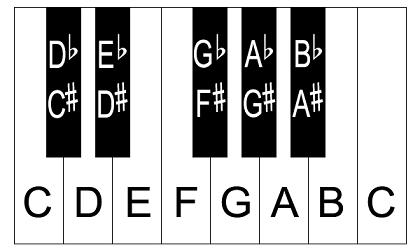
NAMES OF THE PIANO KEYS

The White colour keys

The white keys on the piano have their name and they are name alphabetical order from A to G

Looking at the diagram of the piano keys above, you will notice  patterns like 2black keys and 3black keys.. Did you? Ok good!!!

Now first white key before the piano is named the "C KEY" the second key after the C is called D and the third key is called E
Now we have gotten  to the white key before the 3black keys, the name of the key is F. The  white key after F is G and the 

white key after G is A  and the white key after A is B then it continues with key C...
The Black colour keys

 The black keys don't have a name, they are named accordingly to  the white keys but they are called sharp of the white key when ascending and flat of the white key when descending..
The first black key after the C key is called C sharp because it is ascending and it's also called D flat  when descending from D.   when descending, the black are called the flat of the white key after them. for clearer understanding check mage fig 1.2 and fig 1.3


                                               fig 1.1
                                              fig 1.2
                                                 fig 1.3

Key signature


Definition
 The key signature of a piece of music is the sharps or flats listed after the clef. This is to avoid the repetition of accidentals in the score. They are listed on every line of music, which signifies what
key he/she has chosen.

TYPE OF SIGNATURE
* sharp sign (see image fig 1.4)
* flat sign (see image fig 1.5)
* Natural sign (see image fig 1.6)

Sharp sign

in musical notation,
sharp means "higher in pitch by a semitone (half step)," and has an associated sharp symbol, ♯, which may be found in key signatures or as an accidental. Sharp is contrasted with flat, which refers to a lowering of pitch.


Flat sign

 In music, flat , or bemolle (Italian: "soft B") means "lower in pitch". In music notation, the flat symbol, ♭ derived from a stylised lowercase "b", lowers a note by a half step (semitone). Intonation or tuning is said to be flat when it is below the true pitch.


Natural sign

In musical notation, a natural sign (♮) is an accidental sign used to cancel a flat or sharp from either a preceding note or the key signature.

                                                          fig 1.4
fig 1.5


                                                       fig 1.6


To be continued
To get more lessons please follow blog...

Don't forget to place a comment.. Thank you all ☺